
Good Will Hunting came out TWENTY-NINE years ago. I grew up outside Boston and I was about Will’s age when it was released. I took home economics in high school with one of the kids who Matt and Ben fight, in slow-mo, on a basketball court. Will Hunting was this unbelievable character who worked as a janitor and solved mathematical problems that stumped the academics he cleaned up after.
I couldn’t relate to his background or, thankfully, his level of pain, but the soul searching with Robin Williams, his brotherhood with Ben Affleck, his messy romance with Minnie Driver, and the film’s exploration of life and love were enough for 21-year-old me to watch it twice in the theater on the same day.
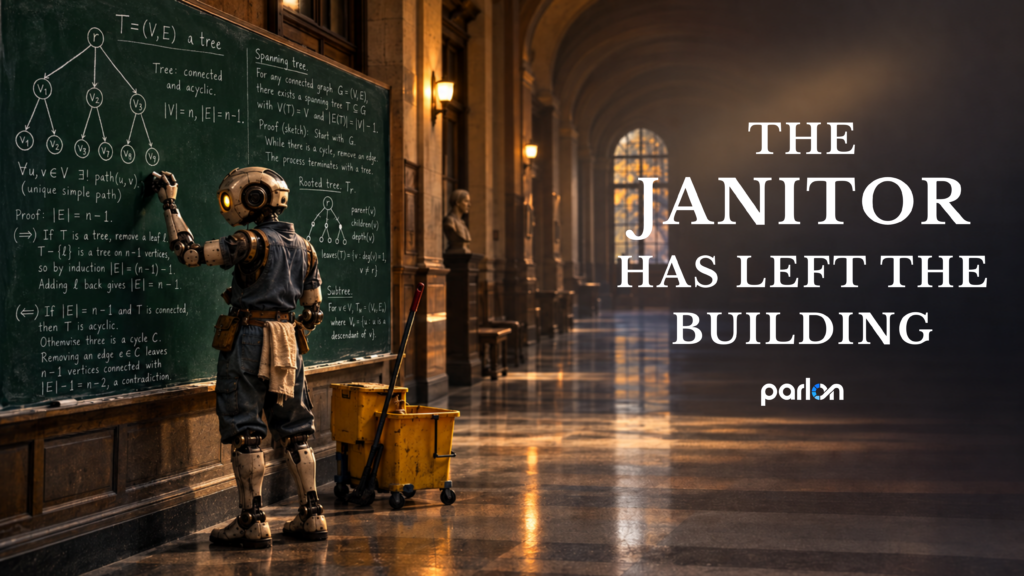
The Chalkboard
The scene everybody remembers begins with a problem left on a hallway chalkboard by Professor Gerald Lambeau. Graduate students walk past it. Professors walk past it. Then somebody solves it, and nobody knows who. Eventually Lambeau catches the janitor writing on the board and assumes he’s vandalizing it. That janitor is Will.
From there, the mathematics almost stops being the point. I’ve heard rumblings ever since that the problem wasn’t really that difficult, but it did what it needed to do: we knew Will could solve it.
The next two hours are about trying to understand Will.
Three Decades Later
A few weeks ago, another difficult math problem got solved, and this one was harder. OpenAI says its AI solved the Navier–Stokes existence and smoothness problem, which had been open for roughly 90 years and is one of the famous Millennium Prize Problems. It threw something on the order of 10,000 AI agents at it, and 88 hours later, the answer was on the board.
There’s a wrinkle, though. Unlike Professor Lambeau and his poor teaching assistant, the mathematicians trying to understand the proof are struggling to read this one. Not because it is wrong. OpenAI also produced a formal, machine-checked verification of the proof, which is strong evidence the formal argument is correct. The problem is that the paper does a poor job of explaining itself. One mathematician told NPR that it doesn’t make clear which parts are important, which are routine, or how its ideas connect to other mathematics.
The robot got the answer. The humans are still trying to figure out what it learned.
Where’s Will?
Back to Good Will Hunting for a second. In 1997, the mystery was the person. Someone had solved the problem, and everybody wanted to know who.
In 2026, we know who solved it: the robot army.
The mystery is everything else. How did they get there? What mattered, and what didn’t? What happened across 10,000 agents and 2.7 million messages that produced something humans are still struggling to explain? And the bigger question: what happens when this stops being unusual?
The Answer Isn’t the Whole Thing
There is a temptation to look at a story like this and conclude that people have become less important. I’m not sure that’s right. I think we’ve confused producing an answer with understanding how we got there. Those used to travel together, because a person had to do one to accomplish the other. AI is starting to pull them apart, and that makes understanding, context, judgment and visibility more valuable, not less.
It’s why I spend so much time thinking and talking about observability. As AI systems become more autonomous, the output isn’t the difficult part anymore. The difficult part may be understanding what thousands of agents, models, applications, GPUs, networks and infrastructure components did between the question and the answer, the prompt and the action. At Parlon, that’s the world we’re building for. If the answer appears on the chalkboard, I’d like to know a little more about what happened before we all start erasing it and moving on.
The movie ends with Will driving away, and we never find out what becomes of him.
I still miss him.