
Fewer tools. Reduced cost.
More innovation.
The tools were bought at different times, for different reasons. The pain is one story: a sprawling, expensive stack that stands still while the infrastructure around it keeps changing. Parlon replaces overlapping legacy and active monitoring tools with one normalized platform, one data model, one contract.
Watch how Parlon consolidates the stack.
It isn't one problem. It's three, compounding.
Tool sprawl
A legacy fault-management platform and a separate synthetic testing tool, among 4 to 10 tools in the average stack, each with its own schema, alert logic, and renewal date. Nobody owns reconciling them by hand.
Stalled innovation
Feature investment slows after acquisition or under private-equity ownership. What today's stack actually needs, AI workload visibility included, arrives late, costs extra, or doesn't arrive at all.
Rising cost
Renewal costs climb for reasons that have nothing to do with value delivered: forced subscription conversions, annual escalators, bundled products nobody asked for.
What a fragmented stack does. What one normalized platform does instead.
- Vendor-specific data stored as-is, reconciled by hand across tools
- Fault management and synthetic testing sold, licensed, and renewed separately
- Static thresholds firing from systems that don't talk to each other
- AI and LLM workload visibility: absent, or a paid add-on if it exists at all
- Every source mapped to one schema the moment it arrives
- Synthetics and telemetry natively unified: one console, one data model
- Alert Auto-Tune™ learns your environment; correlates and de-duplicates, ~70% less noise
- MCP and LLM-aware synthetic checks included as a standard check type, not an add-on
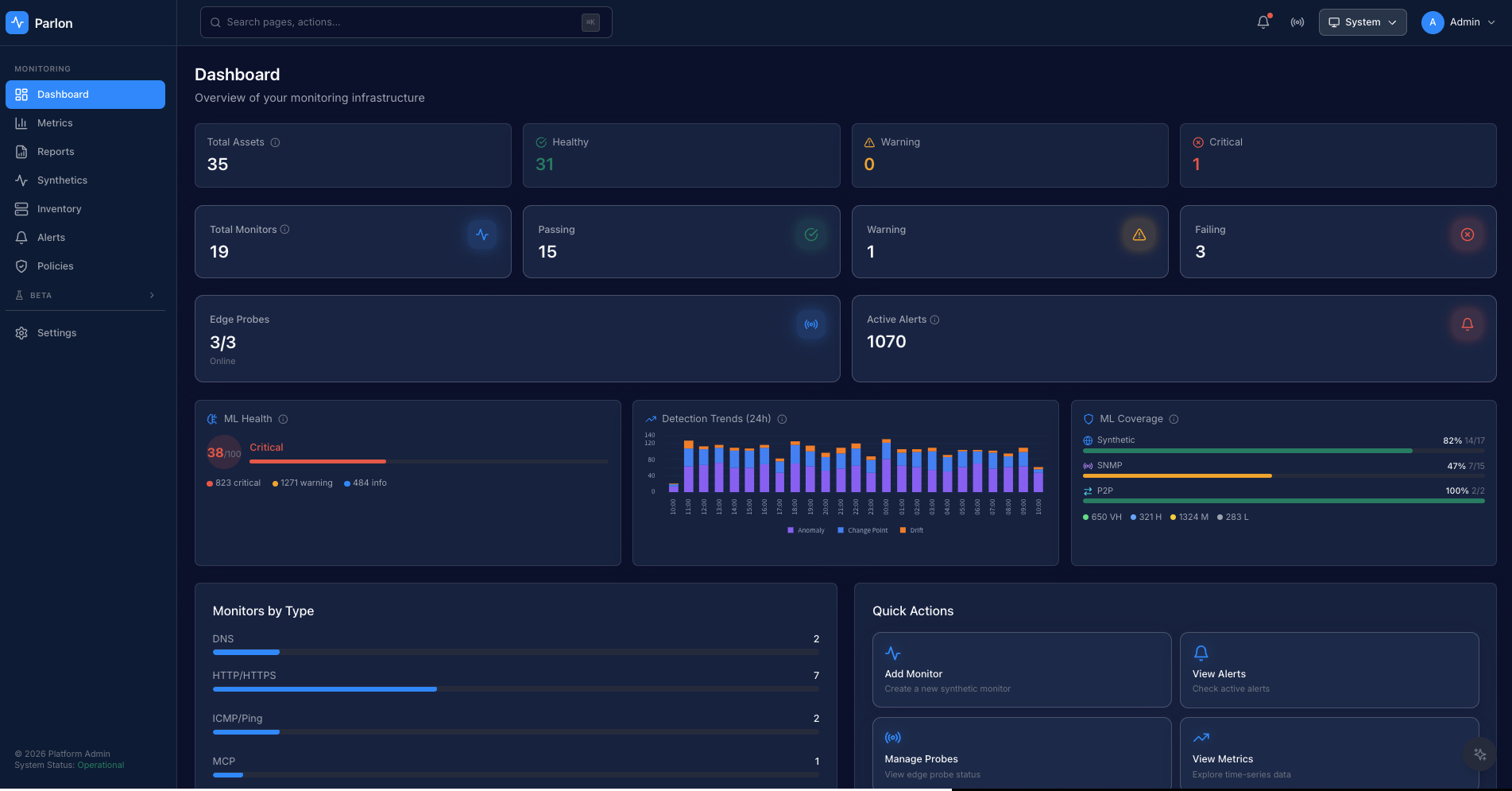
Structural capabilities, not feature updates.
Normalization at ingest
Fault data and synthetic tests alike, mapped into one schema the moment they arrive. Vendor detail preserved, correlation instant, not reconstructed later.
Synthetics + telemetry, unified
Active synthetic testing and continuous telemetry monitoring in one native system. No second platform, no swivel chair between them.
Alert Auto-Tune™
Learns baselines, correlates and de-duplicates alerts across what used to be two tools' worth of noise. Roughly 70% less of it, confirmed with live customers.
Deploy anywhere
SaaS, on-premises, hybrid, or fully air-gapped. Runs alongside the tools it's replacing from day one. No forklift, no big-bang cutover.
3–8x lower total cost of ownership.
Three-year TCO, 500–5,000+ device deployments. Legacy platforms carry license, hardware, and professional-services costs that Parlon's SaaS-first, normalization-first architecture was built to avoid.
| Cost category | Legacy platforms | Parlon |
|---|---|---|
| Annual license | $30K–$1M+ | $35K–$150K ACV |
| Infrastructure / hardware (Yr 1) | $10K–$300K | $0 (SaaS) |
| Professional services (Yr 1) | $5K–$500K | Minimal |
| Ops headcount (fully loaded/yr) | 1–5 FTE ($150K–$750K/yr) | 0.25–0.5 FTE (~$37K–$75K/yr) |
| Est. 3-year TCO | $400K–$4.5M+ | ~$175K–$600K3–8X LOWER |
Infrastructure metrics breadth
Decades of vendor certifications and device support run deep. Parlon closes this through normalization: whatever's already deployed feeds the same unified schema, so breadth becomes a data-source problem, not a platform limitation.
On-prem deployment maturity
Legacy platforms have a longer on-prem operational history. Parlon's on-prem and fully air-gapped deployments are in production today, including HIPAA-compliant environments.
Switching is a 30- to 60-day proof of value.
Deploy
Synthetics active within hours. Installed alongside the existing stack. Zero disruption.
First value
Blind spots surfaced. Normalized telemetry flowing. Coverage gaps identified.
Baselines
Alert Auto-Tune™ learns behavior. Parallel alerting builds confidence.
Proof complete
30–60 day proof of value done. Alerts validated against the incumbents.
Decision made
Replacement confirmed. Incumbent renewal bypassed.
Decommissioned
Full displacement. Legacy tools off contract.
One platform replaced two, at about half the cost.
“We found Parlon's capabilities beyond parity with the legacy vendors, and the simplicity of deployment and the cost were a significant value in themselves.” — Network Infrastructure Lead, healthcare enterprise (1,000+ clinic locations, on-premise, air-gapped, HIPAA-compliant)
Wherever your data has to live.
SaaS
Fastest path to value. Fully managed, day-zero deployment.
On-premises
Runs entirely inside your infrastructure, no external dependency.
Hybrid
Mix SaaS and on-prem by environment, without splitting your data model.
Air-gapped
No external connectivity required. In production today, HIPAA-compliant.
Before you start the clock.
We're mid-contract with one or both vendors. Can we still evaluate Parlon?
Yes, and it's the best time to start. Parlon deploys alongside your existing stack without disrupting operations. By the time either contract comes up for renewal, you'll have 60–90 days of parallel proof already complete.
Will Parlon really cover what both of our tools cover today?
For the vast majority of enterprise infrastructure, yes. Parlon's Normalization Engine handles standard network gear, cloud environments, and application stacks out of the box, and unifies the fault-management and synthetic-testing coverage you run separately today.
How long does a real consolidation actually take?
The 90-day timeline above is conservative. Synthetic monitoring is live within hours of deployment. Normalized telemetry flows within the first week. Most customers feel confident enough to decommission the incumbents within 60–90 days, some faster.
Our board expects proven platforms, not a startup. How do we justify consolidating onto one?
The founding team built the platforms your board already considers proven. Parlon is capitalized through self-funding and venture backing, reflecting conviction and investor confidence.
Bring the stack you've stopped trusting.
We'll walk through the three pains against your own environment and build a scoped, real-numbers consolidation case together.
REQUEST A DEMO