
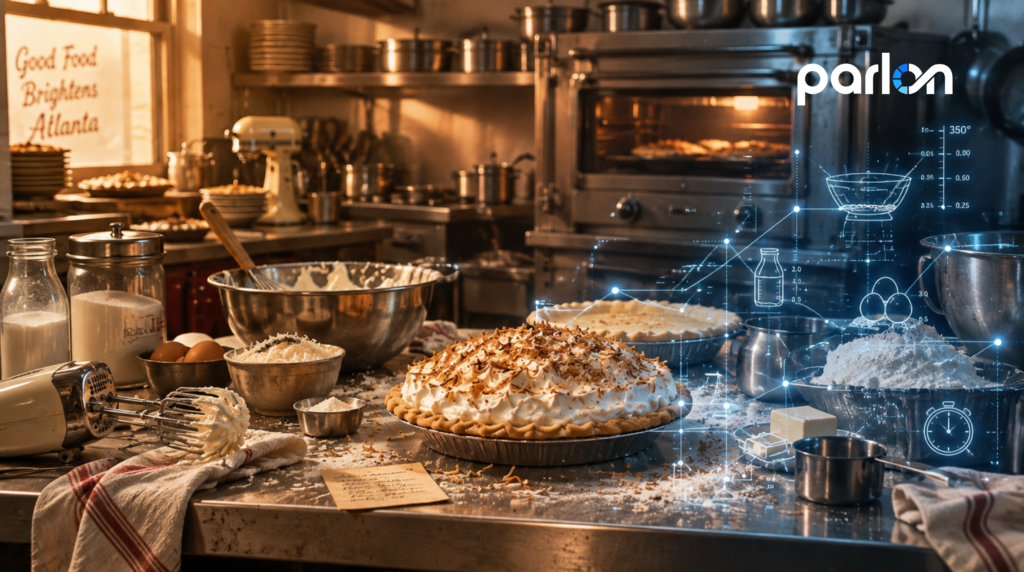
I dare say that most people here on LinkedIn have never heard of Zelma Calhoun.
And it’s a shame, not only because the name Zelma Calhoun is pure literature and belongs in everyone’s vocabulary, but mostly because of what she accomplished.
Most people have now heard of the restaurant chain Chick-fil-A, but what many probably don’t realize is that the Chick-fil-A chicken sandwich was born at a little restaurant outside Atlanta called the Dwarf Grill, later renamed the Dwarf House.
The name came from the diminutive size of the establishment, not from some now-inappropriate reason. The original restaurant had just ten stools and four booths.
From its beginnings as an old-school diner, the Dwarf Grill featured classic Southern staples like mac and cheese, fried okra and, of course, pie.
Brothers Truett and Ben Cathy founded the restaurant. The pies fell to Zelma.
Zelma Calhoun started working there in 1954, while she was still in high school. She stayed more than 45 years and became the restaurant’s lead pie maker. By the end of her career, she had made more than 650,000 pies.
The Pie Lady
My stepmother grew up in Atlanta, and like many people from her generation, mastered the art of cooking not from classes, videos or cookbooks, but from the masters who came before her.
Zelma was one of those masters.
As the story goes, my stepmother so enjoyed the Dwarf House’s coconut cream pie that she marched right into the kitchen and asked Zelma for the recipe.
After some understandable hesitation and negotiation, the two ladies came to some sort of agreement. My stepmother could watch Zelma make the dessert, from memory, and try to recreate it at home for her own family.
There was no recipe card, no tidy list of measurements written in teaspoons and cups. Just Zelma making pies the way she had made them thousands of times before while my stepmother watched.
And that presented a problem.
Two Dozen Pies
When you learn from someone making two dozen pies at a time, dividing everything by twenty-four doesn’t get you the same result.
A larger quantity heats differently. Moisture evaporates differently. Ingredients interact differently. The size of the pan matters. The oven matters. Timing matters. Sometimes something that works at one scale refuses to cooperate at another.
So my stepmother did what people did before Google, YouTube and AI could answer nearly any question in seconds.
She experimented.
She made a pie, tasted it, changed something and made another. Eventually she got close. There was only one peculiar problem: the recipe worked when she made two pies, but one never came out quite right.
The Shortcut
I was thinking about this story recently because the entire exercise would look different today.
Give an AI model everything my stepmother remembered seeing in Zelma’s kitchen. Tell it Zelma was making two dozen pies. Give it the approximate ingredients and process, then ask it to reverse-engineer a recipe for two pies, or even one.
I suspect it would land close on the first try.
It could convert the quantities, explain why dividing a commercial batch by twenty-four might not work, account for evaporation, surface area and cooking time, suggest temperatures and troubleshoot a filling that refused to set.
What took my stepmother weeks of trial and error might now take a few minutes of conversation. That changes a lot. It doesn’t change one thing: a person still must make the pie.
You Still Need the Oven
You would still need the ingredients and the oven. You would still need to understand what the filling was supposed to look like as it cooked. You would still need to notice that the coconut was browning too quickly, or that the custard wasn’t setting, or that whatever came out of the oven didn’t look the way it was supposed to.
And you’d have to taste the pie.
That distinction matters more to me now than it used to.
We spend an enormous amount of time talking about what artificial intelligence will be able to do: write the code, configure the system, diagnose the problem, recommend the change and, before long, make the change itself.
There is every reason to believe it will keep getting better at all of those things.
But generating an action and producing the desired result are not the same thing.
What Happened Next?
In hindsight, what my stepmother was doing in that kitchen was a tight little feedback loop: watch, attempt, observe the result, adjust and try again.
What mattered wasn’t that she had access to Zelma’s knowledge. She had access to Zelma’s behavior.
She could see what Zelma did, try to reproduce it, observe what happened and make changes based on the result.
The same distinction is starting to matter in technology, too.
As AI makes it cheaper and faster to generate code, make recommendations, configure infrastructure and eventually take autonomous action, the ability to take the action may become the least interesting part of the equation.
The important questions come right after.
Did it work?
Did the system behave the way we expected? Did fixing one thing unexpectedly break another? And when the answer is no, can we see enough of what happened to understand why?
The faster the action gets, the more the feedback loop matters.
Someone Still Has to Taste the Pie
There is a temptation when talking about AI to assume that intelligence eliminates the messy parts that came before it.
Perhaps sometimes it will.
But I suspect much of the world will work more like Zelma Calhoun’s coconut cream pie.
AI may get us to the recipe faster. It may give us a better starting point than we ever could have found ourselves, and it may save us days, weeks or years of trial and error.
But the recipe is still only a hypothesis until something happens in the real world.
You still need the ingredients and the oven. You still need to watch what happens.
And someone still has to taste the pie.
About Parlon
Parlon is an infrastructure observability platform built for intelligent infrastructure. It offers three ways in: AI Infrastructure Observability, Observability Modernization and Active Synthetic Testing, all on one normalized platform underneath. Three entry points. One platform. Nothing bolted on.
Parlon calls this behavior-first observability. The goal isn’t just to collect signals or know whether something is up or down. It’s to understand how a system behaves, catch the moment it starts diverging from what it’s supposed to do, and give teams the context to respond, adjust and improve.
Parlon brings that view across the infrastructure, applications and AI workflows today’s business runs on.